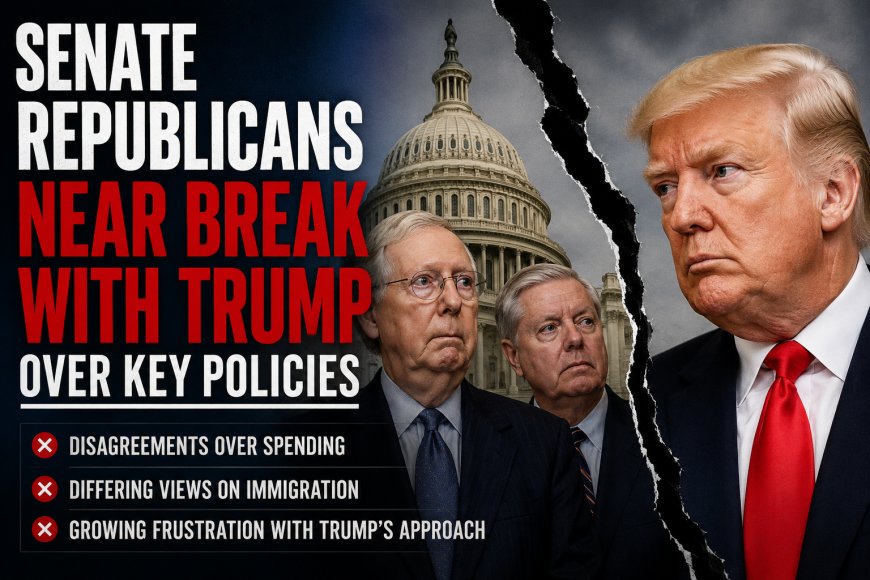
Senate Republicans Near Break with Trump Over Key Policies
Senate Republicans show growing resistance to Donald Trump’s agenda amid policy disputes, election pressure, and rising internal GOP divisions in Congress.
 Ellofacts
Senate Republicans Near Breaking Point as Rift with Donald Trump Widens
Tensions are increasingly visible between Senate Republicans and former President Donald Trump, as growing numbers of GOP lawmakers show a willingness to publicly oppose parts of his political and policy agenda. What was once a tightly unified Republican front is now showing signs of strain ahead of upcoming elections.
Growing Republican Resistance on Capitol Hill
In recent weeks, several Republican senators have taken positions that directly challenge Trump-backed initiatives. Lawmakers have pushed back against proposals tied to funding a new White House ballroom project, questioned a Department of Justice compensation plan for individuals the administration claims were wrongly treated by federal agencies, and raised concerns over high-profile appointments linked to Trump allies.
One particularly controversial decision involved Trump’s nomination of Bill Pulte, a close political supporter without intelligence experience, to a senior role overseeing national intelligence functions. The move triggered unease among some Republicans who worry about credibility, qualifications, and long-term institutional trust.
Midterm Pressure Reshaping GOP Strategy
The shifting tone inside the Republican Party is also being driven by political survival. With many Senate seats up for re-election in the coming cycle, lawmakers are increasingly focused on voter sentiment in their home states rather than party loyalty alone.
Sen. Thom Tillis of North Carolina, who is not seeking re-election, acknowledged this political reality, noting that concerns about maintaining Republican control of Congress are becoming more urgent as the election season approaches. His remarks reflect a broader sentiment among GOP senators who fear that controversial votes tied closely to Trump could become liabilities in competitive races.
Foreign Policy Disagreements Add to Friction
Foreign policy has also become another point of division. As tensions in the Middle East continue, both chambers of Congress have taken steps to rebuke elements of the administration’s approach to Iran-related military strategy. Some Republican lawmakers have joined Democrats in expressing concern that the United States risks becoming further entangled in prolonged conflict.
This rare bipartisan pushback signals that disagreement with Trump’s policy direction is no longer limited to a small faction within the party.
A Notable Senate Vote Signals Deep Unease
The growing discomfort within Republican ranks became more visible during a recent Senate vote on Trump’s proposed “anti-weaponisation” fund. The initiative, which Democrats criticised as a politically motivated “slush fund” for allies of the former president, faced resistance even from within the GOP.
Three vulnerable Republican senators — Susan Collins of Maine, Dan Sullivan of Alaska, and Jon Husted of Ohio — broke ranks and voted alongside Democrats to block the measure. Although the effort ultimately failed, the vote highlighted a widening gap between Trump-aligned priorities and the electoral calculations of swing-state Republicans.
A Party Balancing Loyalty and Survival
While most Republican senators remain cautious about directly confronting Trump, the growing number of defections on key votes suggests a gradual shift. Party leaders are now navigating a delicate balance between maintaining loyalty to a dominant political figure and responding to the electoral risks that come with it.
As one GOP senator privately noted, the closer the election gets, the more lawmakers are forced to weigh party alignment against voter backlash.
The result is a Republican Party that appears increasingly fractured on Capitol Hill — and one where open disagreement with Trump is becoming less politically risky than it once was.