
Can Zoom Agent Architect Redefine Enterprise AI CX?
Zoom launches Agent Architect and Agent Performance Suite to help enterprises build, optimise, and scale AI agents with outcome-based pricing.
 Ellofacts
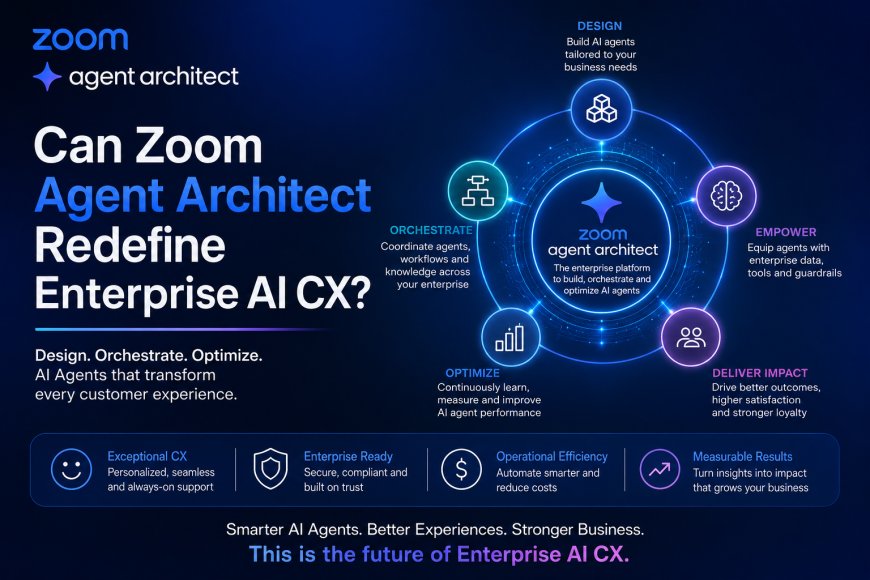
Can Zoom’s Agent Architect Transform the Future of AI-Powered Customer Experience?
Zoom is making a major push into the enterprise AI market with the introduction of Agent Architect and Agent Performance Suite, two new capabilities designed to help organisations build, deploy, monitor, and optimise AI-powered customer service agents at scale. The launch marks a significant step in Zoom’s strategy to compete with leading technology companies in the rapidly evolving conversational AI and customer experience (CX) space.
As businesses increasingly adopt artificial intelligence to automate customer interactions, one of the biggest challenges has been moving beyond experimental projects and achieving measurable business outcomes. Zoom believes its latest offerings can help bridge that gap by providing enterprises with a complete AI agent lifecycle management platform.
A New Approach to Building AI Agents
Agent Architect is designed to simplify the creation of sophisticated AI agents. Instead of requiring extensive technical expertise, organisations can generate intelligent virtual agents using simple prompts. The platform enables businesses to create customer-facing AI assistants that can handle conversations across multiple channels while integrating with existing enterprise systems.
The goal is to reduce development complexity and accelerate deployment timelines. Companies can quickly design AI agents capable of managing customer inquiries, resolving support requests, and providing personalised experiences without extensive coding requirements.
This approach aligns with the growing demand for low-code and no-code AI solutions, allowing business teams to participate more actively in digital transformation initiatives.
From Deployment to Continuous Improvement
One of the most notable aspects of Zoom’s announcement is the introduction of the Agent Performance Suite. While many AI platforms focus primarily on agent creation, Zoom is emphasising ongoing performance management throughout the entire lifecycle of an AI agent.
The suite includes simulation tools, validation capabilities, and advanced analytics that help organisations evaluate how AI agents perform before and after deployment. Businesses can monitor important metrics such as customer resolution rates, response accuracy, customer satisfaction levels, and cost per resolution.
These insights allow organisations to identify weaknesses, optimise workflows, and continuously improve AI performance. By providing a feedback-driven environment, Zoom aims to help enterprises achieve greater reliability and consistency in customer interactions.
Addressing Enterprise Concerns Around AI
Many organisations remain cautious about large-scale AI adoption due to concerns surrounding reliability, hallucinations, compliance, security, and governance. AI-generated responses that contain inaccurate information can negatively impact customer trust and brand reputation.
Zoom’s lifecycle management strategy seeks to address these concerns through testing, monitoring, and validation mechanisms that help organisations maintain quality control over their AI deployments. By allowing businesses to simulate customer interactions before launch, the platform may reduce risks associated with real-world implementation.
This capability is particularly important as enterprises increasingly rely on AI to handle customer support operations across global markets.
The Rise of Outcome-Based Pricing
Another major element of Zoom’s strategy is the introduction of outcome-based pricing. Rather than charging solely based on user licenses or software seats, the company plans to align pricing with measurable business outcomes generated by AI agents.
Under this model, organisations pay based on the value delivered by the platform, such as successful issue resolution, customer support automation, or operational efficiency gains. This approach reflects a broader industry shift where businesses demand stronger accountability from technology investments.
Outcome-based pricing can reduce financial risk for customers while encouraging vendors to focus on delivering tangible results rather than simply providing access to technology.
Competing in a Crowded AI Market
Zoom’s latest move places it in direct competition with major technology providers, including Microsoft, Google, Amazon Web Services (AWS), Salesforce, ServiceNow, and emerging AI-focused companies.
Several customer service platforms have already embraced performance-based pricing models. Companies such as Zendesk, Intercom, and Decagon are increasingly charging customers based on successful AI-driven resolutions rather than traditional subscription structures.
However, Zoom’s potential advantage lies in combining pricing innovation with comprehensive lifecycle management. By offering both AI agent creation and performance optimisation within a single ecosystem, the company hopes to provide enterprises with a more integrated solution.
Global Scalability and Personalisation
Modern enterprises require AI solutions capable of supporting multiple languages, regional requirements, and customer expectations across diverse markets. Zoom's platform includes support for multi-location deployments and localised customisation, enabling organisations to adapt AI experiences for different regions.
The company is also investing in customer context capabilities that allow AI agents to deliver more personalised interactions. By leveraging customer history, preferences, and behavioural data, businesses can create experiences that feel more relevant and human-like.
If executed effectively, these features could help organisations improve customer satisfaction while reducing support costs.
Challenges Ahead
Despite the promising capabilities, Zoom faces significant execution challenges. Enterprise customers expect seamless integration with existing CRM platforms, business applications, and data systems. Security, compliance, and governance requirements also continue to grow as AI adoption expands.
Furthermore, competition in the conversational AI sector is intensifying. Established technology giants possess extensive cloud infrastructure and AI resources, while specialised startups continue to innovate rapidly.
Success will depend on Zoom’s ability to demonstrate real-world business value, maintain AI reliability, and help customers achieve measurable improvements in customer experience outcomes.
Looking Forward
The launch of Agent Architect and Agent Performance Suite signals Zoom’s ambition to become a major player in enterprise AI and customer experience automation. By combining AI agent development, performance monitoring, outcome-based pricing, and scalable deployment capabilities, the company is addressing some of the most pressing challenges facing AI adoption today.
As enterprises increasingly seek solutions that deliver measurable ROI rather than experimental AI features, Zoom’s lifecycle-focused strategy could position the company favourably in the next phase of conversational AI evolution. The coming months will reveal whether its approach can accelerate enterprise adoption and redefine how organisations build and manage AI-powered customer experiences.