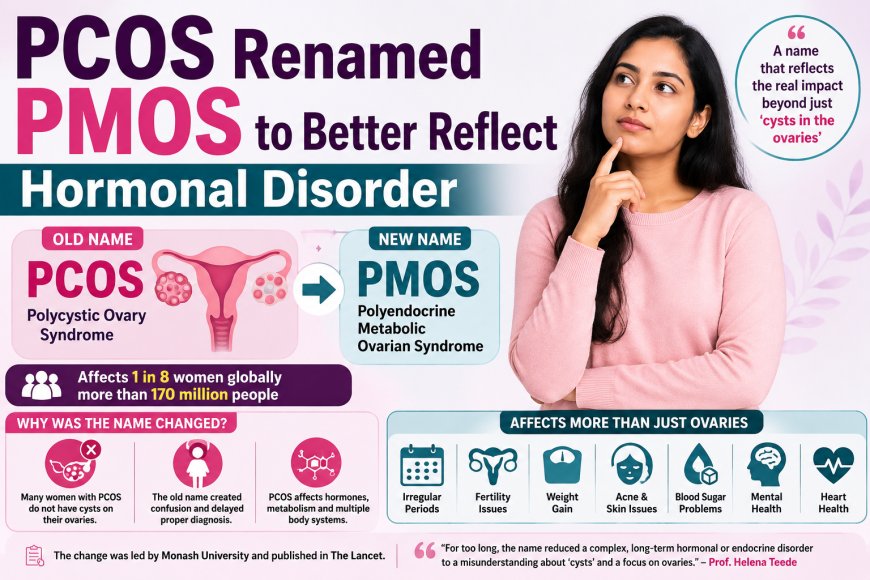
A major change in women’s healthcare terminology has officially renamed Polycystic Ovary Syndrome (PCOS) to Polyendocrine Metabolic Ovarian Syndrome (PMOS). Medical experts say the updated name more accurately reflects the condition’s wide-ranging hormonal and metabolic impact rather than limiting it to ovarian cysts alone.
The change comes after an international research initiative led by Monash University and published in The Lancet. Researchers and doctors believe the earlier term “Polycystic Ovary Syndrome” created years of misunderstanding about the condition, often delaying diagnosis and treatment for millions of women worldwide.
Health experts explain that the old name focused mainly on “polycystic ovaries,” leading many people to assume the disorder only involved ovarian cysts. However, many women diagnosed with PCOS do not actually have cysts on their ovaries. The condition is instead a complex endocrine and metabolic disorder that affects multiple systems in the body.
PMOS can influence menstrual cycles, fertility, hormone balance, insulin resistance, weight gain, acne, hair growth, mental health, blood sugar levels, and even cardiovascular health. Because of its broad impact, specialists felt the older name failed to represent the seriousness and complexity of the disorder.
According to medical studies, the condition affects nearly one in eight women globally, impacting more than 170 million people worldwide. Despite being one of the most common hormonal disorders among women, many patients often go undiagnosed for years because symptoms are dismissed as stress, lifestyle changes, or normal hormonal fluctuations.
Professor Helena Teede, Director of the Monash Centre for Health Research & Implementation, stated that the old terminology oversimplified a long-term endocrine disorder by reducing it to a misunderstanding about ovarian cysts.
Doctors believe the new PMOS terminology may improve awareness, encourage earlier diagnosis, reduce stigma, and help patients receive more accurate treatment focused on both hormonal and metabolic health. The renaming is also expected to improve public understanding that the condition extends far beyond reproductive health alone.

 Ellofacts