US-Iran Peace Deal Signed June 19: Oil Prices Fall Sharply
US and Iran agree to historic peace deal with signing set for June 19 in Switzerland. Oil prices fall sharply as Strait of Hormuz reopening is announced.
 Ellofacts
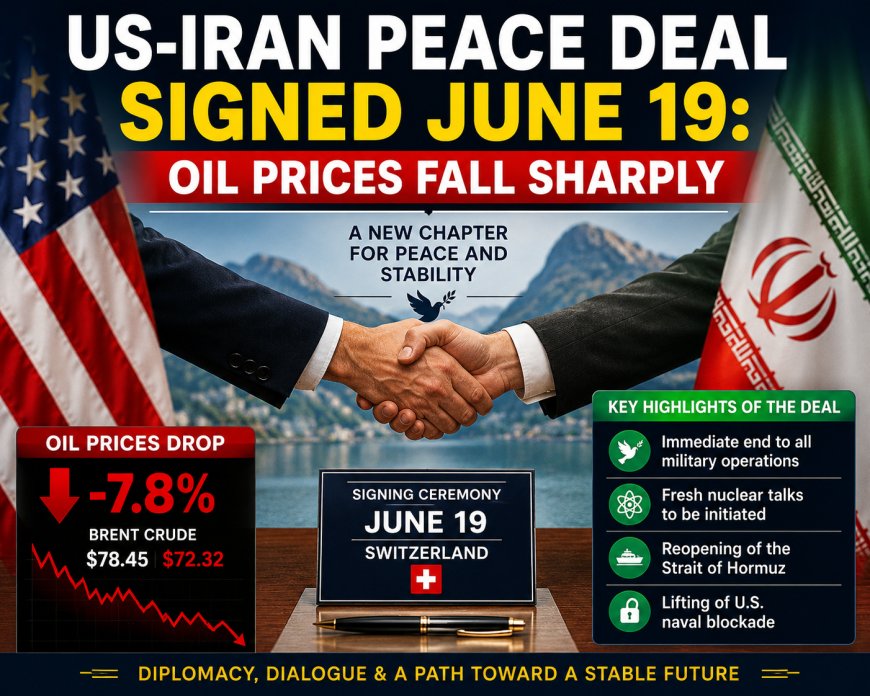
U.S. and Iran Reach Historic Peace Deal; Signing Scheduled for June 19
In a major geopolitical development, the United States and Iran have officially agreed to a comprehensive peace deal, marking a significant shift in relations between the two long-time adversaries. The agreement includes an immediate halt to all military operations, signaling one of the most important diplomatic breakthroughs in recent years.
A formal signing ceremony is scheduled to take place on June 19 in Switzerland, where both nations are expected to finalize the terms of the agreement in the presence of international observers.
Key Highlights of the Peace Agreement
The newly announced deal reportedly includes several critical components aimed at restoring stability in the Middle East and global energy markets:
-
Immediate end to all U.S.–Iran military activities
-
Restart of diplomatic and nuclear negotiations
-
Commitment to fresh talks on Iran’s nuclear program
-
Gradual reopening of the Strait of Hormuz, a vital global oil route
-
Lifting of the long-standing U.S. naval blockade in the region
Officials from both sides have described the agreement as a step toward “long-term peace and regional stability,” though final implementation details are still expected to be clarified during the signing event.
Global Oil Markets React Sharply
Following the announcement, global financial markets responded almost instantly. Crude oil prices saw a significant decline as traders reacted to the easing of geopolitical tensions.
-
Brent crude prices dropped sharply in early trading
-
Investors welcomed the possibility of stable oil supply routes
-
Energy markets moved on expectations of reduced supply risks
The reopening of the Strait of Hormuz is expected to play a key role in stabilizing global oil shipments, as the passage is one of the world’s most important energy transit routes.
Why the Strait of Hormuz Matters
The Strait of Hormuz is a strategic waterway connecting the Persian Gulf to global markets. Nearly a fifth of the world’s oil supply passes through it, making it a critical chokepoint for international energy security.
Any disruption in this region typically leads to volatility in global oil prices, which explains the immediate market reaction following the peace announcement.
What Happens Next?
The upcoming signing ceremony in Switzerland on June 19 is expected to:
-
Formalize the peace agreement
-
Outline the roadmap for nuclear negotiations
-
Set timelines for easing sanctions and naval restrictions
-
Establish monitoring mechanisms for compliance
Diplomatic teams from both countries are also expected to begin preparatory talks ahead of the official signing.
Conclusion
The U.S.–Iran peace agreement represents a potentially historic turning point in global diplomacy. While the deal still awaits formal signing and implementation, early reactions suggest optimism across financial markets and international political circles.
However, analysts caution that the success of the agreement will depend on how effectively both nations follow through on commitments in the coming months.