Vedanta Removed from MSCI Indexes After Demerger Move
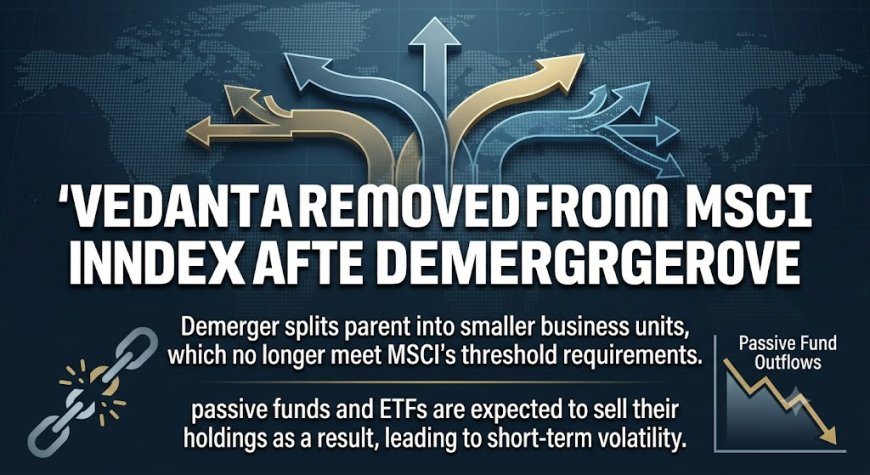
Vedanta Ltd will be removed from MSCI Global Standard Indexes after its demerger into multiple entities, reshaping passive fund flows and investor outlook.
 Ellofacts
Vedanta to Exit MSCI Global Standard Indexes After Demerger Move
Vedanta Ltd is set to be removed from the MSCI Global Standard Indexes following its major corporate restructuring through a demerger into multiple business verticals. The change will take effect from June 22, 2026, marking a significant shift for passive index investors tracking the stock.
MSCI Confirms Removal After Corporate Restructuring
According to MSCI’s official update, Vedanta Ltd will be excluded from both the MSCI Standard Index and Large Cap Index following its recent business split. The decision comes after the company reorganised its operations into five separate listed entities, reducing the consolidated market capitalisation of the original parent company.
The demerger includes the creation of:
- Vedanta Aluminium
- Vedanta Power
- Vedanta Oil & Gas
- Vedanta Iron & Steel
- Vedanta Ltd (remaining holding entity)
These entities began listing on Indian stock exchanges, including the NSE and the BSE, earlier this month.
Why Vedanta Is Being Removed from MSCI Indexes
MSCI indexes track companies based on factors like:
- Market capitalisation (m-cap)
- Free float liquidity
- Global investability standards
After the demerger, Vedanta’s combined market value was split across multiple entities, significantly reducing the size of the parent company. As a result, it no longer meets MSCI’s threshold requirements for inclusion in the Global Standard Indexes.
Impact on Investors and Market Reaction
The removal from MSCI indexes is expected to have short-term volatility impacts on Vedanta shares.
Key expected effects:
- Passive foreign funds tracking MSCI may reduce holdings
- Possible large-scale selling pressure during rebalancing
- Increased stock volatility around the effective date
- Temporary price fluctuations due to index adjustments
Market experts suggest that index exclusion often leads to capital outflows from institutional investors, especially ETFs and index funds.
Recent Performance of Vedanta Shares
Following the MSCI announcement, Vedanta shares saw mild weakness in trading.
- Closing price: ₹299.95 (down 0.84%)
- Previous close: ₹302.50
- Intraday reaction: Announcement made during market hours
Before the demerger, Vedanta traded around ₹773 per share, but after the adjustment (ex-demerger), the effective price stabilised near ₹290.
Demerger Impact on Shareholders
Existing shareholders benefited from a 1:1 share allocation ratio, receiving shares in all newly formed companies.
For every Vedanta Ltd share held, investors received:
- 1 share of Vedanta Aluminium
- 1 share of Vedanta Power
- 1 share of Vedanta Oil & Gas
- 1 share of Vedanta Iron & Steel
This restructuring aims to unlock value by allowing each business vertical to operate independently and attract sector-specific investors.
Performance of Newly Listed Entities
Post listing, the newly created companies saw mixed market reactions:
- Vedanta Iron & Steel: Hit 5% upper circuit
- Vedanta Power: Trading higher
- Vedanta Aluminium: Hit 5% lower circuit
- Vedanta Oil & Gas: Declined around 5%
This reflects early-stage volatility typical after demerger-based listings.
Why Vedanta Undertook This Demerger
The Vedanta Group’s restructuring is aimed at:
- Unlocking shareholder value
- Improving business transparency
- Creating focused sector leaders
- Attracting targeted institutional investment
- Aligning with India’s industrial growth strategy
By separating business verticals, each entity can pursue independent strategies and capital allocation decisions.
What Investors Should Watch Next
Investors tracking Vedanta should monitor:
- MSCI index rebalancing flows
- Institutional fund exit or entry trends
- Performance of newly listed subsidiaries
- Post-demerger valuation adjustments
- Short-term volatility near June 22, 2026
Final Outlook
The removal of Vedanta from MSCI Global Standard Indexes marks a significant transitional phase for the company. While it may trigger short-term selling pressure, the long-term impact depends on how effectively the newly formed entities perform independently in their respective sectors.
The market will now closely watch whether the demerger truly unlocks value or increases fragmentation risk for investors.