
RBI Tightens Rules on Banks to Stop Mis-Selling Products
RBI has tightened rules for banks to prevent mis-selling, forced bundling and digital dark patterns, ensuring stronger customer consent and transparency from 2027.
 Ellofacts
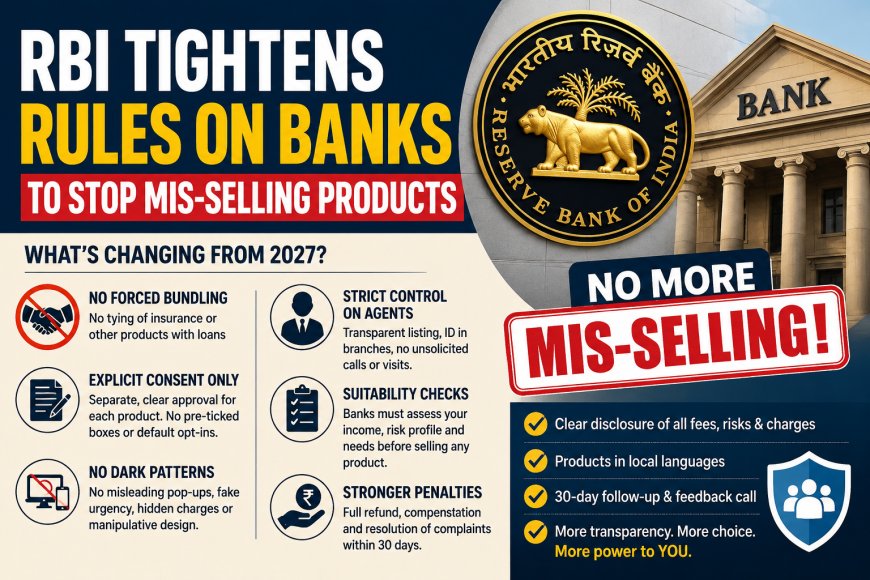
RBI Puts Its Foot Down: Banks Barred From Forcing Unwanted Financial Products
The Reserve Bank of India (RBI) has introduced sweeping new rules aimed at ending mis-selling, forced bundling, and manipulative digital sales tactics by commercial banks. The move is being seen as one of the strongest consumer protection frameworks in India’s banking sector in recent years.
Under the new “Responsible Business Conduct” directions, banks will no longer be allowed to push financial products that customers do not need or did not explicitly request. The regulations will come into force on January 1, 2027, giving banks time to overhaul their systems, sales practices, and digital platforms.
A Major Shift in Banking Consumer Protection
For years, customers have complained about being pushed into buying insurance, credit protection plans, or investment products while applying for simple services like loans or fixed deposits. The RBI’s latest framework directly targets these practices.
The central bank has now clearly defined and legally classified mis-selling, making it easier to identify, regulate, and penalise such behaviour.
Mis-selling includes situations where:
- A product does not match the customer’s financial profile
- Wrong or incomplete information is provided
- Products are sold without clear consent
- One product is forced as a condition for another
- Any practice already flagged by other financial regulators is involved
If mis-selling is proven, banks must refund the full amount and compensate customers for any financial loss.
Forced Bundling of Products Now Prohibited
One of the most significant changes is the strict ban on compulsory bundling.
Banks can no longer require customers to buy insurance or additional financial products as a condition for loan approval.
For example:
- A home loan cannot be tied to a mandatory insurance policy from a bank’s partner
- Personal loans cannot include forced credit protection add-ons
However, banks can still recommend insurance if it is genuinely needed for risk management. The key difference is that customers must be free to choose any provider.
Voluntary bundling—where customers actively opt in—remains allowed.
Consent Rules Become Strict and Explicit
The RBI has tightened what “customer consent” really means in banking.
Under the new rules:
- Consent must be explicit and product-specific
- One approval cannot be used for multiple products
- Pre-ticked boxes and default opt-ins are banned
- Each product requires a separate approval step
- Digital interfaces must set the default consent to “No”
- Consent records must be stored for at least one year after the relationship ends
Banks must also clearly display all important product details, such as:
- Interest rates
- Feess
- Risks
- Lock-in periods
- Exit penalties
This ensures customers understand what they are signing up for before agreeing.
Digital Mis-Selling and “Dark Patterns” Banned
The RBI has also taken a strong stance on manipulative app and website design practices, commonly known as dark patterns.
Banks are now prohibited from using tactics such as:
- Fake urgency messages like “Offer ends soon”
- Pre-added insurance or add-ons during checkout
- Confusing opt-out buttons (“No, I don’t want security”)
- Pop-ups that redirect users without consent
- Difficult cancellation or subscription traps
- Hidden charges revealed late in the process
- Misleading ads disguised as alerts or notifications
- Repeated permission requests after rejection
- Confusing checkbox wording to trick users into opting in
- Highlighting only expensive or preferred options visually
All digital platforms must undergo regular internal audits to ensure compliance.
Stricter Control Over Sales Agents and DSAs
Direct Selling Agents (DSAs) and Direct Marketing Agents (DMAs), who often act as intermediaries between banks and customers, are now brought under tighter RBI supervision.
Banks are required to:
- Maintain a publicly available list of all agents
- Ensure agents are clearly identifiable in branches
- Collect formal compliance agreements from agents
- Restrict customer contact hours to 9 AM – 7 PM
- Prohibit unauthorised home or office visits
- Ban agents from posing as bank employees
Any violation will make banks directly accountable for agent behaviour.
Suitability Checks Before Selling Financial Products
Banks are now required to assess whether a product is suitable for a customer before selling it.
This includes evaluating:
- Income level
- Age and financial stability
- Risk tolerance
- Financial literacy
- Product complexity
This means banks cannot aggressively sell high-risk or complex products to unsuitable customers.
Additionally:
- Product documents must be available in local languages
- Separate forms must be used for each product
- Customers must receive a follow-up feedback call within 30 days
Strong Penalties for Mis-Selling
The RBI has introduced strict consequences:
- Full refund of mis-sold products
- Compensation for customer losses
- Mandatory complaint resolution within 30 days
- Accountability for both banks and agents
This creates direct financial risk for institutions that violate rules.
Industry Pushback and Policy Background
The issue of mis-selling has been under scrutiny for years. Regulators and policymakers have repeatedly flagged aggressive cross-selling in banks as a major concern.
The Finance Ministry has also raised alarms, stating that forced insurance selling increases borrowing costs and reduces transparency for customers.
Insurance regulators and financial experts have similarly noted that banks, due to their large customer base, have often been misusing their position as trusted financial institutions to push unnecessary products.
What Changes for Customers from 2027
Once the rules take effect:
- No forced insurance with loans
- No misleading pop-ups or app traps
- No hidden charges or unclear pricing
- No cold calling or visits without consent
- No bundled products without explicit approval
- Clear visibility of all costs and risks before purchase
Customers will have significantly more control over financial decisions, both in branches and on digital platforms.
Final Outlook
The RBI’s new framework represents a major shift toward customer-first banking in India. It aims to eliminate long-standing issues of mis-selling, restore trust in digital banking systems, and enforce accountability across banks and their sales networks.
While implementation will take time, the regulations set a clear direction:
Banks must sell transparently, ethically, and only with informed consent.