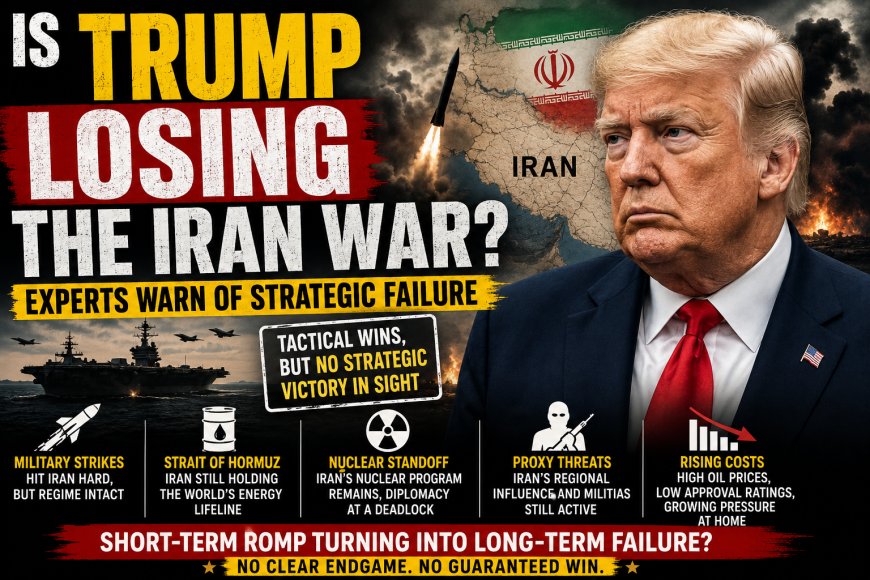
Is Trump Losing the Iran War? Experts Warn of Strategic Failure
Experts question Donald Trump’s Iran strategy as tensions rise, diplomacy stalls, and fears grow over a prolonged geopolitical and economic crisis.

US President Donald Trump is facing mounting scrutiny over his administration’s ongoing conflict with Iran, as political analysts and foreign policy experts increasingly question whether the United States is drifting toward a long-term strategic setback despite early military successes.
Nearly three months after launching military operations against Iran, the Trump administration continues to claim that its objectives have largely been achieved. However, critics argue that the broader geopolitical outcome remains uncertain, with tensions still high across the Middle East and diplomatic negotiations showing limited progress.
At the beginning of the conflict, US-led strikes significantly weakened several Iranian military installations, targeted missile infrastructure, and disrupted sections of Tehran’s naval capabilities. Yet despite those tactical victories, Iran has maintained substantial influence in the region and continues to exert pressure through its strategic position near the Strait of Hormuz — one of the world’s most important oil shipping routes.
Analysts believe this has complicated Trump’s efforts to frame the operation as a decisive geopolitical victory. The Strait of Hormuz remains critical to global energy markets, and concerns persist that Iran still retains the ability to disrupt nearly one-fifth of global oil and gas shipments if tensions escalate further.
Former US negotiators and foreign policy experts have warned that what initially appeared to be a short-term military campaign is increasingly becoming a prolonged geopolitical challenge. Some observers argue that while Iran has suffered severe military and economic damage, it has also demonstrated resilience by surviving sustained American pressure and maintaining leverage in regional politics.
The conflict has also created political pressure for Donald Trump domestically. During his election campaign, Trump repeatedly promised to avoid unnecessary foreign wars and criticised previous US administrations for prolonged military interventions abroad. Critics now say the Iran crisis risks damaging his foreign policy credibility and complicating his political standing ahead of key elections in the United States.
Rising fuel prices and concerns about global energy stability have further intensified domestic criticism. Analysts suggest that prolonged instability in the Gulf region could continue affecting oil markets and consumer prices, adding pressure on the White House.
At the centre of the dispute remains Iran’s nuclear programme. Trump had stated that one of the administration’s primary goals was to permanently block Tehran’s path toward developing nuclear weapons. However, reports suggest that Iran still retains significant stockpiles of highly enriched uranium, and negotiations regarding nuclear restrictions remain unresolved. Iranian officials continue to insist that their nuclear programme is intended for peaceful purposes and oppose demands to halt uranium enrichment entirely.
Some security experts believe the conflict may actually encourage Iran to accelerate its nuclear ambitions in the long term, arguing that countries under military threat often seek stronger deterrence capabilities. Comparisons have frequently been drawn with nuclear-armed nations such as North Korea.
Another major challenge for the Trump administration has been Iran’s continued support for regional proxy groups and allied militias. Despite repeated military operations, Washington has not fully succeeded in reducing Tehran’s regional influence across parts of the Middle East. Analysts believe Iran still retains the ability to destabilise neighbouring countries through allied armed networks and drone capabilities.
Internationally, the conflict has also affected America’s relations with traditional allies. Several European nations reportedly expressed concerns about the military campaign and criticised the lack of broader international consultation before the escalation. At the same time, global powers such as China and Russia are believed to be closely studying the conflict and assessing weaknesses exposed in American military strategy and supply chains.
Supporters of the Trump administration, however, argue that the operation has already delivered strategic gains. They point to the weakening of Iran’s military infrastructure, stronger security coordination with Gulf allies, and increased pressure on Tehran’s economy as evidence that the campaign has achieved meaningful results. White House officials maintain that all military options remain available if diplomacy fails.
Despite these claims, uncertainty continues to dominate discussions around the conflict’s long-term outcome. Experts warn that the administration still lacks a clearly defined endgame, while Iran appears determined to withstand economic and military pressure for as long as necessary.
As diplomatic efforts continue alongside ongoing regional tensions, the larger question remains unresolved: whether the Trump administration can transform military success on the battlefield into lasting political and strategic victory — or whether the conflict will ultimately become a prolonged challenge with global consequences.
Ellofacts