India’s rise as a nuclear power is one of the most defining chapters in its modern strategic history. The journey began in the deserts of Pokhran and ultimately transformed India’s place in global politics, defence policy, and international diplomacy. From the first nuclear test in 1974 to the decisive Pokhran-II tests in 1998, India demonstrated not only scientific capability but also the determination to protect its sovereignty in an increasingly uncertain world.
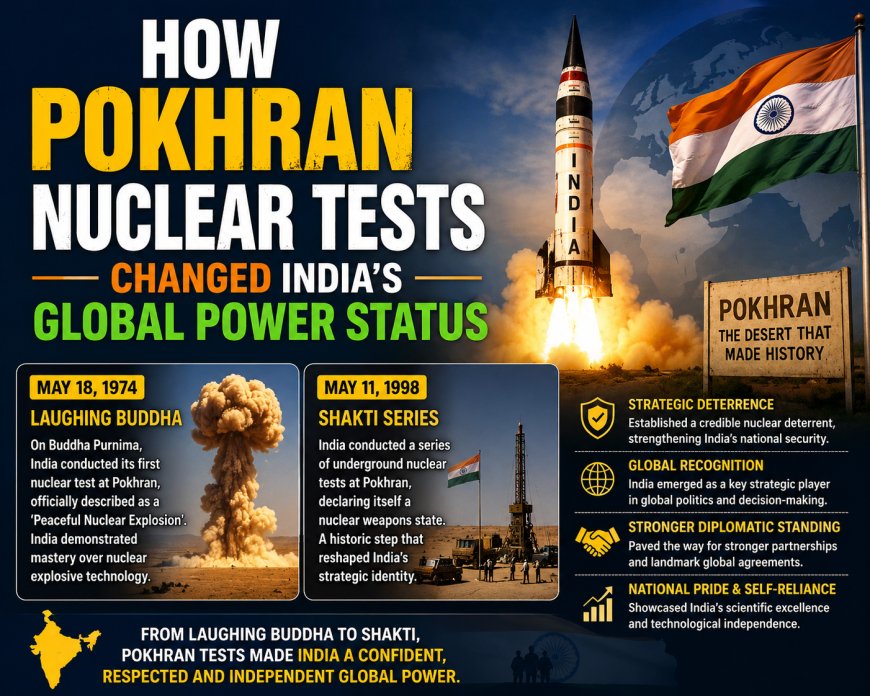
On May 18, 1974, India conducted its first nuclear test at Pokhran in Rajasthan under the codename “Laughing Buddha.” The test coincided with Buddha Purnima and was officially described as a “Peaceful Nuclear Explosion.” Led by Prime Minister Indira Gandhi, the operation marked a major technological breakthrough for India. While the government maintained that the test was intended for peaceful purposes, the global community immediately recognised its strategic implications. India had successfully demonstrated its ability to develop nuclear explosive technology, becoming the first nation outside the five recognised nuclear powers to carry out such a test.
The “Laughing Buddha” test placed India firmly on the global strategic map. However, it also triggered international concern and led to technology restrictions and sanctions from several Western nations. Despite the pressure, India continued to strengthen its indigenous scientific and defence capabilities over the following decades. The country maintained a policy of strategic ambiguity, neither fully declaring itself a nuclear weapons state nor abandoning its nuclear ambitions.
Nearly 24 years later, India took a historic and far more assertive step. On May 11, 1998, under Prime Minister Atal Bihari Vajpayee, India conducted a series of underground nuclear tests known as Pokhran-II or the Shakti tests. Carried out in extreme secrecy amid the blistering heat of the Thar Desert, the tests stunned the world and marked India’s official entry into the league of nuclear-armed nations.
The Pokhran-II tests included multiple nuclear detonations designed to demonstrate different capabilities, including thermonuclear and fission devices. Two days later, on May 13, India conducted additional tests, confirming its advanced nuclear expertise. The successful operations showcased the strength of India’s scientific community and military planning, as the tests were completed without detection by major global intelligence agencies.
The 1998 tests fundamentally altered India’s strategic identity. By openly declaring its nuclear weapons capability, India ended decades of uncertainty and established a credible nuclear deterrent. The move significantly strengthened India’s defence posture, particularly in the context of regional security challenges involving neighbouring nuclear powers China and Pakistan.
While the tests initially invited international criticism and economic sanctions, India gradually emerged stronger diplomatically. Over time, many global powers recognised India’s strategic importance, responsible nuclear doctrine, and democratic stability. This shift eventually paved the way for stronger defence partnerships and landmark agreements, including the India-US Civil Nuclear Deal in 2008, which effectively acknowledged India as a responsible nuclear state despite it not being a signatory to the Nuclear Non-Proliferation Treaty (NPT).
The Pokhran tests also boosted national pride and symbolised India’s growing self-reliance in science, technology, and defence. Scientists such as Dr APJ Abdul Kalam played a crucial role in the success of the programme, becoming national icons for their contributions to India’s strategic strength.
Today, both the 1974 “Laughing Buddha” test and the 1998 Shakti series are remembered as turning points that reshaped India’s global standing. They marked India’s transition from a developing nation seeking strategic space to a confident global power capable of defending its interests independently. The legacy of Pokhran continues to influence India’s defence policy, foreign relations, and vision of strategic autonomy in the modern world.

 Ellofacts