
Meta, Microsoft Job Cuts Spark AI Labor Crisis Fears
Meta and Microsoft job cuts raise fears of an AI-driven labour crisis. Over 92,000 tech layoffs in 2026 spark concerns about the future of jobs.
 Ellofacts
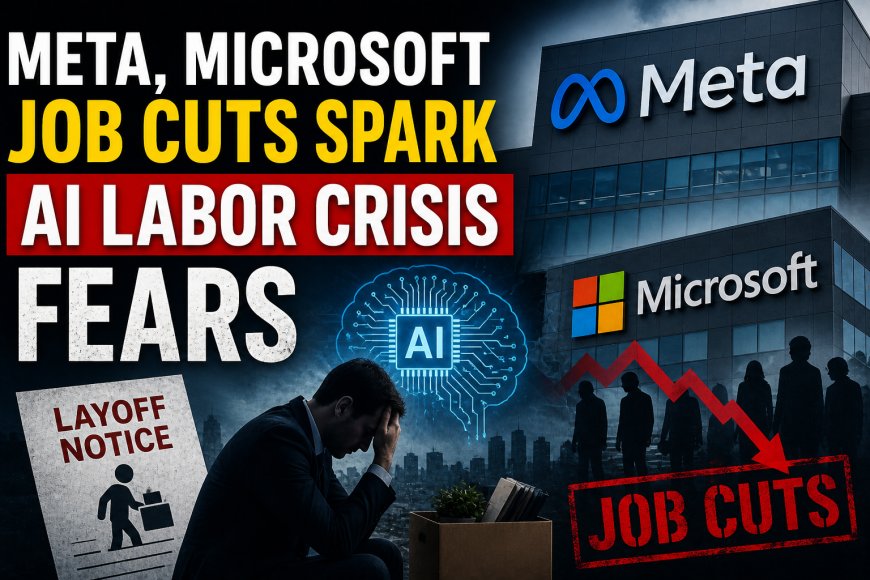
Over 20,000 Job Cuts at Meta and Microsoft Raise Fears of AI-Driven Labour Crisis
More than 20,000 potential job cuts announced by Meta Platforms and Microsoft have intensified concerns that an AI-driven labour disruption is already underway—not a distant possibility. These developments come shortly after Amazon carried out its largest layoffs in history, signalling a broader trend across the tech industry.
AI Investments vs Workforce Reductions
Ironically, the same companies investing billions into artificial intelligence infrastructure are also cutting jobs to improve efficiency. Alongside AI-driven automation, firms are still adjusting their workforce after aggressive hiring during the pandemic years.
According to Layoffs. fyi, more than 92,000 tech workers have been laid off in 2026 alone, bringing the total number of layoffs since 2020 to nearly 900,000.
Experts Warn of Structural Shift
Industry experts believe this is not a temporary slowdown but a deeper transformation in how work is structured.
Anthony Tuggle, an executive coach with experience in AI, describes the situation as a “fundamental structural shift,” suggesting that businesses are redefining how tasks are performed and who performs them.
Rising Anxiety in the Workforce
Concerns about job security have been growing since OpenAI launched ChatGPT in 2022, showcasing the power of modern AI tools. These fears intensified further with advancements like Claude, which demonstrated the ability to handle complex workflows traditionally managed by entire teams.
Job Loss vs Job Creation Debate
While some experts argue that AI will ultimately create new job categories—just as past technological revolutions did—there is growing concern about a mismatch between job losses and job creation.
A 2026 Motion Recruitment report indicates that:
- Hiring for entry-level and general IT roles is slowing
- Demand for AI specialists is rapidly increasing
- Overall tech salaries remain mostly flat, except for high-demand AI roles
Rajat Bhageria, CEO of Chef Robotics, noted that while AI will generate jobs, “it’s still unclear what those roles will look like.”
Layoff Details from Major Companies
- Meta Platforms: Plans to cut 10% of its workforce, roughly 8,000 jobs, starting May 20. The company also intends to cancel around 6,000 open positions to reduce costs and fund AI investments.
- Microsoft: Offering voluntary buyouts to employees, potentially impacting up to 8,750 workers in the U.S.
- Nike: Expanding layoffs beyond tech firms, cutting around 1,400 jobs, mainly in its technology division.
Impact Beyond the Tech Industry
The ripple effect is now visible outside traditional tech companies, suggesting that AI-driven efficiency measures could reshape multiple sectors.
A recent Glassdoor Employee Confidence Index shows that confidence in the tech industry has dropped significantly, with employees increasingly hesitant to switch jobs due to uncertainty.
Changing Workplace Dynamics
Glassdoor’s chief economist, Daniel Zhao, highlights another key trend: fewer employees are voluntarily leaving their jobs. This reduced attrition is forcing companies to take more aggressive measures, such as layoffs or stricter performance evaluations, to manage workforce costs.
Conclusion
The wave of layoffs across major corporations signals a potential turning point in the global job market. As AI continues to evolve, companies are rethinking workforce structures, raising important questions about the future of employment.
While AI promises innovation and new opportunities, the transition may come with short-term disruptions, making it crucial for workers to adapt and upskill in an increasingly automated world.