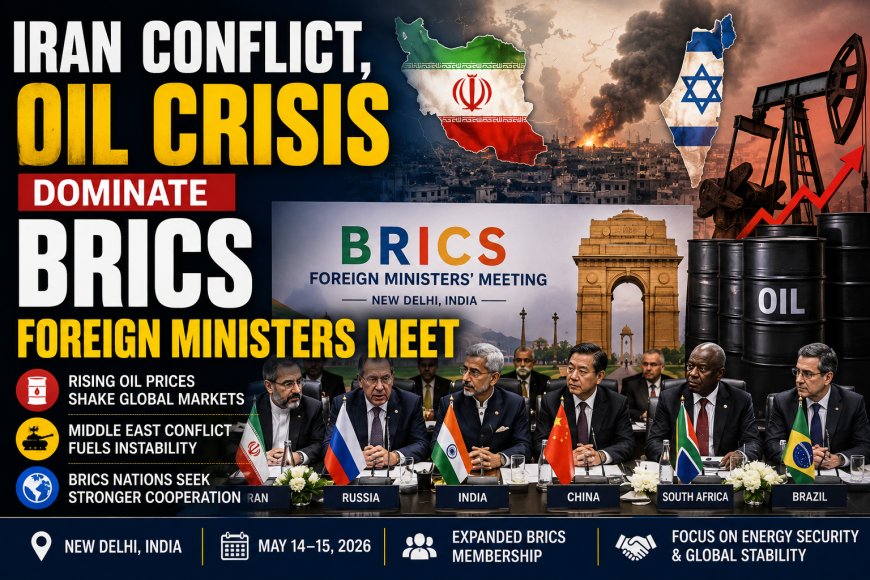
BRICS foreign ministers met in New Delhi, with the Iran conflict, rising oil prices, and global energy security concerns dominating key discussions at the summit.

Foreign ministers from the BRICS nations gathered in New Delhi on Thursday for a crucial meeting expected to focus heavily on the ongoing Middle East conflict and rising global energy concerns. With tensions involving Iran continuing to disrupt oil markets, discussions around fuel security and economic stability are likely to dominate the summit.
India, which currently holds the BRICS presidency, is hosting the two-day meeting of foreign ministers from the expanded bloc. The group now includes countries such as Iran and the United Arab Emirates alongside founding members Brazil, Russia, India, China, and South Africa.
Iranian Foreign Minister Seyed Abbas Araghchi arrived in New Delhi late Wednesday ahead of the summit. Sergey Lavrov also reached the Indian capital and held talks with India’s External Affairs Minister Subrahmanyam Jaishankar.
According to Jaishankar, discussions with Lavrov covered key areas including trade, investment, connectivity, and energy cooperation, along with several global and multilateral issues. He stressed that political cooperation among BRICS nations has become increasingly important amid growing global uncertainty.
The ongoing conflict in the Middle East has created fresh pressure on oil and gas markets, particularly around the Gulf shipping routes and the Strait of Hormuz. The instability has impacted energy-importing countries like India, which relies heavily on Middle Eastern crude oil and fertiliser imports.
Originally formed in 2009, BRICS was created to give emerging economies a stronger voice in global affairs traditionally dominated by Western powers. Over the years, the bloc has expanded significantly, aiming to increase its economic and political influence worldwide.
India is also expected to host the BRICS leaders’ summit later this year, and Prime Minister Narendra Modi is likely to meet the participating foreign ministers during the ongoing gathering.
However, differences among member nations over the Middle East crisis and broader geopolitical issues could make it difficult for the bloc to release a joint statement at the end of the summit.