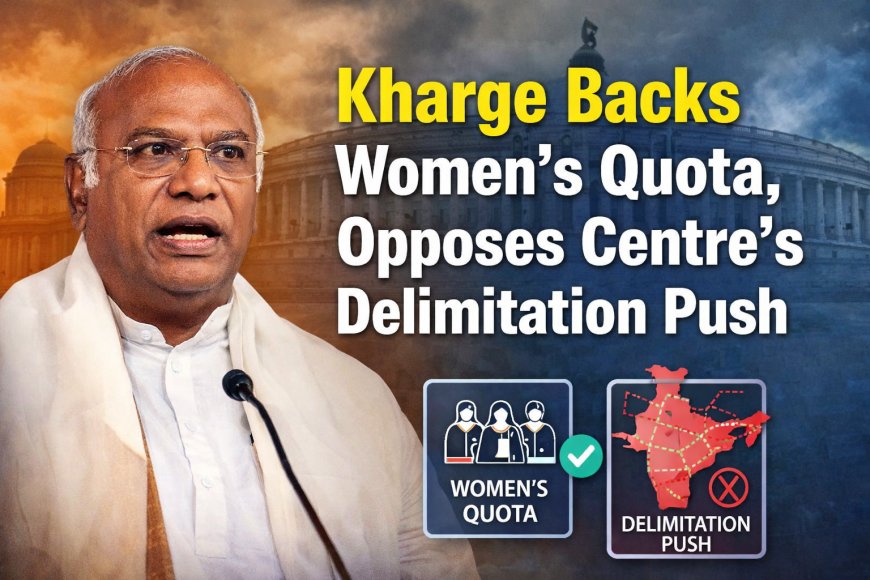
Kharge Backs Women’s Quota, Opposes Centre’s Delimitation Push
Congress chief Mallikarjun Kharge said the Opposition supports women’s reservation but will oppose the Centre’s delimitation-linked approach in Parliament, calling it politically motivated.
 Ellofacts
The India bloc has backed women’s reservation in principle but unitedly decided to oppose the proposed delimitation-linked framework in Parliament.
The Congress and several opposition parties have made it clear that they support women’s reservation as a constitutional reform, but strongly object to the Centre’s method of linking its implementation with a fresh delimitation exercise and seat redistribution formula. After a key strategy meeting in New Delhi, Congress president Mallikarjun Kharge said the disagreement is not with the Women’s Reservation law itself, but with the government’s political approach to executing it.
Kharge stated that the Opposition had earlier supported the women’s quota legislation in both 2010 and 2023, and continues to stand by the idea of greater representation for women in Parliament and state assemblies. However, he alleged that the present move combines reservation with delimitation in a way that could reshape political representation for electoral advantage, which is why the INDIA bloc plans to challenge the proposal during the special Parliament session.
Senior Congress leader Jairam Ramesh also questioned the functioning of the proposed delimitation mechanism, saying the process appears designed to favour the ruling alliance. According to opposition leaders, the use of the 2011 Census as the basis for redrawing constituencies could disproportionately alter seat shares across regions, especially affecting southern and smaller states that have successfully controlled population growth.
The broader opposition meeting saw participation from leaders of the DMK, Trinamool Congress, Samajwadi Party, RJD, Shiv Sena (UBT), NCP(SP), CPI, CPI(M), IUML, and other INDIA bloc partners, reflecting a coordinated effort to resist the delimitation provisions while continuing support for women’s representation. Several parties argued that the issue goes beyond reservation and touches the federal balance of power between states.
A major point of concern for the Opposition is the proposal to expand Lok Sabha seats from 543 to nearly 850 as part of the new framework before the 2029 general election. Critics argue that even if no state loses seats in absolute numbers, the relative influence of southern, north-eastern, and smaller states may decline, shifting the political centre of gravity toward high-population Hindi-belt states.
The numbers in Parliament also make the upcoming debate politically significant. Since constitutional amendments require a special majority in both Houses, the government may find it difficult to pass the related amendment bills without at least partial opposition support. This has increased the stakes of the special session, where the Opposition plans to mount a strong challenge against what it calls a “politically motivated delimitation push.”
Regional parties have also raised concerns over how the new model may affect their states’ future voice in national lawmaking. Leaders from Tamil Nadu, Odisha, Jammu and Kashmir, and several north-eastern states have warned that any formula based solely on older census data without safeguards could weaken the spirit of cooperative federalism.
Overall, the Opposition’s position remains clear: it is firmly in favour of women’s reservation, but is equally determined to resist any delimitation structure that it believes could unfairly alter India’s political map. The issue is now expected to dominate the special Parliament session and shape one of the most important constitutional debates of 2026.