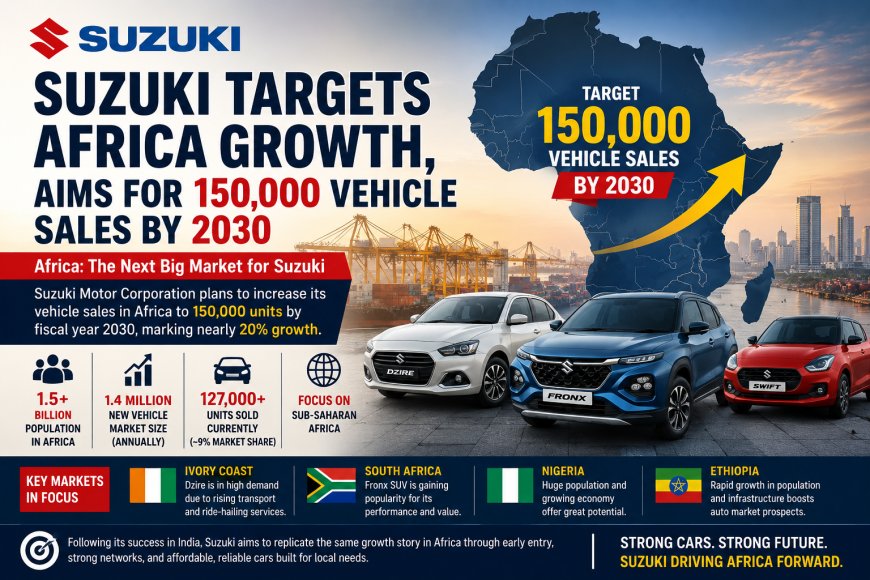
Suzuki Targets Africa Growth, Aims for 150,000 Vehicle Sales by 2030
Suzuki Motor plans to increase Africa sales to 150,000 units by 2030, focusing on emerging markets like South Africa, Nigeria, Ethiopia, and the Ivory Coast.

Suzuki Eyes Africa as Next Growth Engine, Targets 150,000 Vehicle Sales by 2030
JAKARTA: Japanese automaker Suzuki Motor Corporation is accelerating its expansion strategy in Africa, identifying the continent as a key growth market for the coming decade. The company aims to increase its annual vehicle sales in Africa by nearly 20 per cent, reaching 150,000 units by fiscal year 2030.
Africa Becomes Suzuki’s New Focus Market
After achieving remarkable success in India, Suzuki is now applying a similar long-term strategy in Africa. Company executives reportedly view the continent as “the next India” due to its rapidly growing population, increasing urbanisation, and rising demand for affordable personal transportation.
Africa's population has already surpassed 1.5 billion people, making it larger than India in terms of population size. Demographic projections suggest that the continent's population could reach 2.5 billion by 2050, creating significant opportunities for automotive manufacturers.
Strong Potential in Emerging African Economies
The African new vehicle market currently accounts for approximately 1.4 million vehicle sales annually. Suzuki currently sells around 127,000 vehicles across the continent, giving the company a market share of roughly 9 per cent.
Most Suzuki vehicles sold in Africa are manufactured in India, allowing the company to benefit from lower production costs and shorter shipping distances compared to exports from Japan. This strategic advantage helps Suzuki maintain competitive pricing in price-sensitive markets.
Focus on Sub-Saharan Africa
Suzuki is placing particular emphasis on Sub-Saharan Africa, where economic growth and urban development are creating new opportunities for vehicle sales.
In the Ivory Coast, the compact Suzuki Dzire has gained popularity, especially among ride-hailing and transportation service operators. The vehicle's fuel efficiency, affordability, and reliability make it well-suited for commercial use.
Meanwhile, in South Africa, the Suzuki Fronx has emerged as a strong performer. Customers are increasingly attracted to the SUV for its driving dynamics, practicality, and value-for-money proposition.
Nigeria and Ethiopia Offer Future Growth Opportunities
Suzuki also sees substantial potential in Nigeria and Ethiopia, two nations expected to experience strong population growth and economic expansion over the next decade.
As infrastructure improves and middle-class incomes rise, demand for affordable and dependable vehicles is anticipated to increase significantly, creating favourable conditions for Suzuki's expansion plans.
Repeating the Successful India Formula
Suzuki's strategy in Africa closely resembles the approach that helped it dominate the Indian automotive market. During the 1980s, the company entered India earlier than many global competitors, established a strong dealership network, and focused on producing affordable vehicles tailored to local needs.
That early investment eventually transformed Suzuki into one of India's most successful automobile brands. The company now hopes to replicate that achievement across Africa by building strong distribution networks, expanding dealer presence, and offering vehicles that meet local consumer requirements.
Affordable Mobility Remains Suzuki's Strength
Rather than competing in the luxury segment, Suzuki continues to focus on practical, fuel-efficient, and affordable vehicles designed for emerging markets. This strategy aligns well with the needs of many African consumers, where cost-effectiveness, durability, and low maintenance expenses remain key purchasing factors.
As Africa's automotive market continues to mature, Suzuki's early-mover strategy could position the company for significant long-term growth, much like its success story in India.
Ellofacts