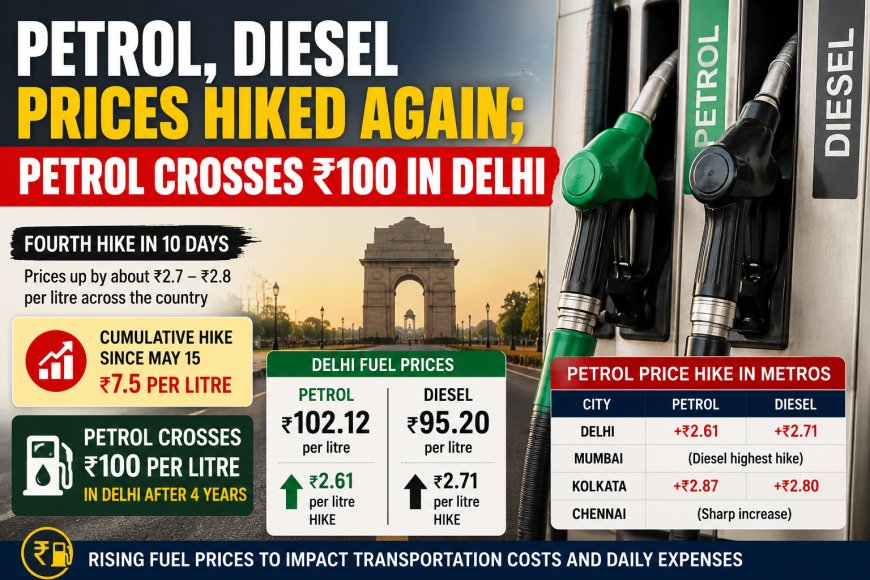
Fuel prices continued their upward trend across India as petrol and diesel rates were increased again on Monday, May 25, 2026. This marks the fourth fuel price revision within a span of just ten days, leading to a significant rise in transportation and daily commuting expenses for consumers nationwide.
The latest hike added nearly ₹2.7 to ₹2.8 per litre to both petrol and diesel prices across different states and fuel variants. With this revision, the cumulative increase in fuel prices since May 15 has reached around ₹7.5 per litre, making it one of the steepest short-term increases in recent months.
In the national capital, petrol prices crossed the psychologically important ₹100-per-litre mark once again after nearly four years. Petrol in Delhi rose by ₹2.61 per litre to reach ₹102.12 per litre, while diesel prices increased by ₹2.71 per litre, taking the rate to ₹95.20 per litre. The last time petrol rates crossed ₹100 in Delhi was during May 2022, when global crude oil prices surged amid geopolitical tensions caused by the Russia-Ukraine conflict.
Among the four major metropolitan cities — Delhi, Mumbai, Kolkata, and Chennai — Kolkata recorded the steepest rise in petrol prices. The city witnessed a ₹2.87 per litre increase, pushing petrol prices to ₹113.51 per litre. Diesel rates in Kolkata also climbed sharply by ₹2.80 per litre to ₹99.82 per litre.
Mumbai saw the highest increase in diesel prices among the metro cities, while Chennai and Delhi also experienced substantial fuel price revisions. The repeated hikes are expected to increase operating costs for public transport, logistics, cab services, and goods transportation across the country. Experts believe that rising international crude oil prices, currency fluctuations, and higher import costs are contributing factors behind the latest fuel rate revisions.
The continuous increase in petrol and diesel prices is likely to affect household budgets as transportation costs influence the prices of essential goods and services. Consumers and businesses are closely monitoring fuel price trends, expecting further clarity from global oil markets and government taxation policies in the coming days.