
ITR Filing Mistakes That Can Delay Refunds in AY 2026-27
Avoid common ITR filing mistakes for AY 2026-27. Learn how errors in income reporting, deductions, and bank details can trigger notices and delay refunds.
 Ellofacts
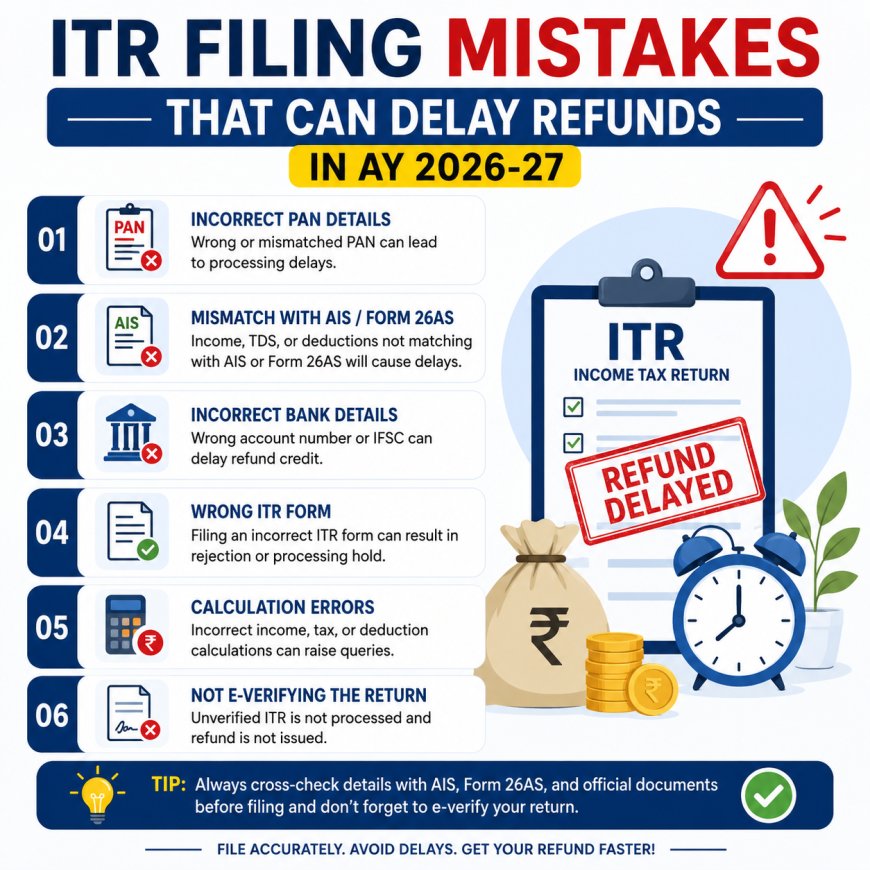
Income Tax Return Filing Mistakes That Can Trigger Tax Notices and Delay Refunds for AY 2026-27
As the Income Tax Return (ITR) filing season for Assessment Year (AY) 2026-27 gains momentum, taxpayers are advised to exercise caution while submitting their returns. Even minor mistakes can lead to tax notices, increased scrutiny from the Income Tax Department, or delays in receiving refunds.
With tax authorities increasingly relying on data analytics and automated verification systems, ensuring accuracy in your ITR has become more important than ever. Here are some of the most common mistakes taxpayers should avoid this filing season.
1. Choosing the Wrong ITR Form
One of the most frequent errors is selecting an incorrect ITR form. Different forms are prescribed for salaried individuals, business owners, professionals, and taxpayers with capital gains or foreign assets.
Filing under the wrong form can result in the return being treated as defective, requiring corrections and potentially delaying refund processing.
2. Not Matching Income with Form 26AS and AIS
Many taxpayers rely solely on Form 16 while filing returns. However, income details should always be cross-checked with:
-
Form 26AS
-
Annual Information Statement (AIS)
-
Taxpayer Information Summary (TIS)
Any mismatch between declared income and information available with the tax department can trigger notices seeking clarification.
3. Failing to Report Interest Income
Interest earned from savings accounts, fixed deposits (FDs), recurring deposits (RDs), and other investments is taxable in many cases.
Taxpayers often forget to disclose these earnings, especially when TDS has already been deducted. However, non-reporting can lead to discrepancies that may attract scrutiny.
4. Ignoring Capital Gains Transactions
Profits from the sale of shares, mutual funds, property, gold, or other assets must be reported accurately.
The tax department receives transaction data directly from financial institutions and exchanges. Failure to disclose capital gains can result in notices and tax demands.
5. Claiming Incorrect Deductions
Claiming deductions without proper documentation is a common reason for tax scrutiny.
Taxpayers should ensure that deductions claimed under sections such as:
-
80C
-
80D
-
80CCD
-
Home loan benefits
-
Education loan interest
are supported by valid proofs and meet eligibility criteria.
6. Incorrect Bank Account Details
Refunds are directly credited to validated bank accounts linked with PAN.
Entering incorrect account numbers, IFSC codes, or failing to pre-validate bank accounts can significantly delay refund processing.
7. Not Reporting Multiple Sources of Income
Individuals earning income from freelancing, rental properties, dividends, consulting work, foreign investments, or side businesses should report all sources accurately.
Incomplete disclosure may lead to mismatches in the department's records.
8. Errors in Personal Information
Simple mistakes such as:
-
Incorrect PAN
-
Wrong Aadhaar number
-
Name mismatch
-
Incorrect date of birth
-
Invalid contact details
can create verification issues and slow down return processing.
9. Missing the ITR Verification Process
Filing the return is only the first step. Taxpayers must verify the return electronically or send the signed verification form within the prescribed deadline.
Failure to verify the ITR may render the return invalid, requiring a fresh filing process.
10. Waiting Until the Last Minute
Last-minute filing often leads to hurried errors, technical glitches, and missing documents.
Early filing provides enough time to reconcile information, correct discrepancies, and receive refunds faster.
11. Incorrect Tax Regime Selection
Taxpayers should carefully compare the old tax regime and the new tax regime before filing.
Choosing a regime without evaluating deductions, exemptions, and overall tax liability can result in paying more tax than necessary.
12. Not Reporting Foreign Assets and Overseas Income
Resident taxpayers holding foreign bank accounts, investments, shares, or earning overseas income must disclose these details wherever applicable.
Failure to report foreign assets can attract stringent penalties and compliance notices.
How to Avoid Tax Notices and Refund Delays
To ensure smooth processing of your ITR for AY 2026-27:
-
Reconcile income with AIS, TIS, and Form 26AS.
-
Select the correct ITR form.
-
Report all sources of income.
-
Verify deduction claims carefully.
-
Validate bank account details.
-
Complete e-verification immediately after filing.
-
Review the return thoroughly before submission.
Conclusion
Accurate and timely filing of Income Tax Returns is essential to avoid unnecessary notices, scrutiny, penalties, and refund delays. A few extra minutes spent reviewing income details, deductions, and personal information can help taxpayers ensure hassle-free compliance during the AY 2026-27 filing season.