IT Stocks Crash: TCS, Infosys Fall After Accenture Cut
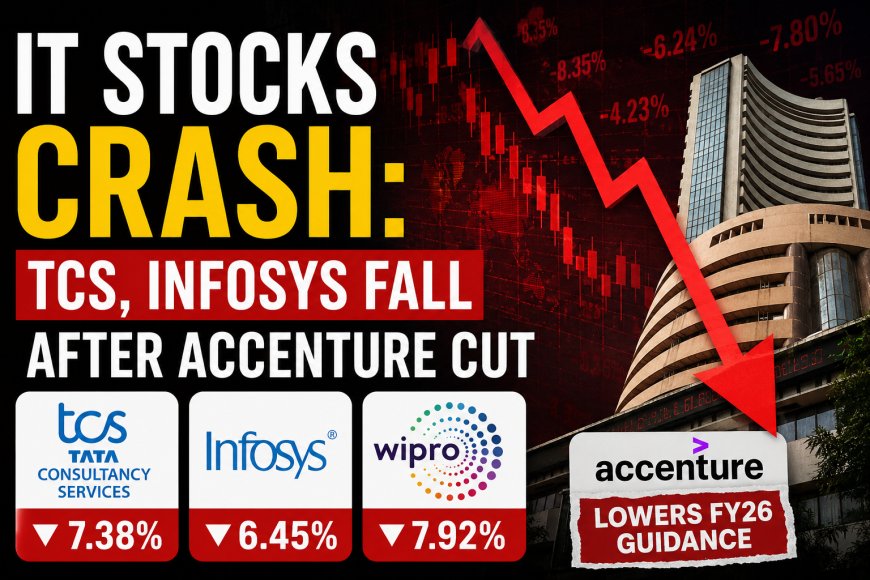
TCS, Infosys, and Wipro shares fell up to 8% after Accenture cut FY26 guidance, raising concerns over global IT demand and future earnings outlook.
 Ellofacts
TCS, Infosys, Wipro Shares Crash Up to 8% After Accenture Cuts FY26 Guidance: What It Means for Indian IT Stocks
Introduction
Indian IT stocks came under heavy selling pressure as major companies like Tata Consultancy Services (TCS), Infosys, and Wipro plunged up to 8% in intraday trade. The sharp fall was triggered after global IT giant Accenture lowered its FY26 revenue guidance, sparking renewed fears of weakening global tech demand.
This sudden downturn has once again highlighted how closely Indian IT services firms are tied to global technology spending trends, especially in the US and Europe.
Why IT Stocks Crashed Today
The primary trigger for the sell-off was Accenture’s cautious outlook. The company signaled:
-
Slower-than-expected global IT spending
-
Delayed client decision-making in large enterprise deals
-
Continued macroeconomic uncertainty in key markets like the US and Europe
-
Pressure on discretionary tech projects such as cloud transformation and digital consulting
Since Indian IT firms derive a large share of revenue from these markets, any downgrade from Accenture often sets off a chain reaction across the sector.
Impact on TCS, Infosys, Wipro and Peers
Following the announcement, Indian IT stocks reacted sharply:
-
TCS slipped significantly as investors feared revenue growth slowdown
-
Infosys saw selling pressure due to exposure to banking and enterprise clients
-
Wipro declined amid concerns over weak deal pipeline conversion
-
Mid-tier IT stocks also mirrored the downturn
The broader Nifty IT index fell sharply, reflecting widespread risk-off sentiment in the sector.
What Accenture’s Guidance Cut Signals
Accenture is often viewed as a global bellwether for the IT services industry. Its revised FY26 outlook suggests:
1. Weak Global Tech Spending
Enterprises are delaying large digital transformation projects due to cost pressures.
2. Slower Cloud & AI Deal Flow
While AI adoption is growing, monetization is still uneven, affecting near-term revenues.
3. Budget Tightening in US & Europe
High interest rates and macro uncertainty are forcing companies to cut discretionary IT spending.
This combination is particularly important for Indian IT companies that depend heavily on outsourcing contracts.
Why Indian IT Stocks Are Highly Sensitive
The sell-off in TCS, Infosys, and Wipro highlights structural dependencies:
-
Over 60% revenue exposure to North America
-
Heavy reliance on BFSI, retail, and tech clients
-
High correlation with global IT consulting peers like Accenture
-
Revenue visibility tied to large, long-term contracts
When Accenture signals caution, it is often interpreted as a forward indicator for Indian IT earnings.
Sector Outlook: Short-Term Pain, Long-Term Stability?
Despite the sharp correction, analysts suggest a mixed outlook:
Near Term (0–6 months)
-
Volatility likely to remain high
-
Deal closures may stay delayed
-
Margin pressure could persist
Medium to Long Term
-
AI-driven transformation could create new revenue streams
-
Cost optimization demand may support outsourcing growth
-
Stable large-cap IT firms may outperform mid-tier players
Investor Sentiment: What Should Be Watched
Market participants will now closely monitor:
-
US Federal Reserve interest rate trajectory
-
Enterprise IT budget updates from global clients
-
Q2 and Q3 earnings guidance from Indian IT firms
-
Deal wins and attrition trends
Any further negative commentary from global IT leaders could deepen the correction.
Conclusion
The sharp fall in TCS, Infosys, Wipro, and other IT stocks reflects growing concerns over global tech demand after Accenture’s FY26 guidance cut. While the short-term outlook appears uncertain, long-term structural drivers like digital transformation and AI adoption remain intact.
For investors, this phase may represent a volatility-driven correction rather than a fundamental breakdown of the IT growth story—though caution is clearly warranted in the near term.