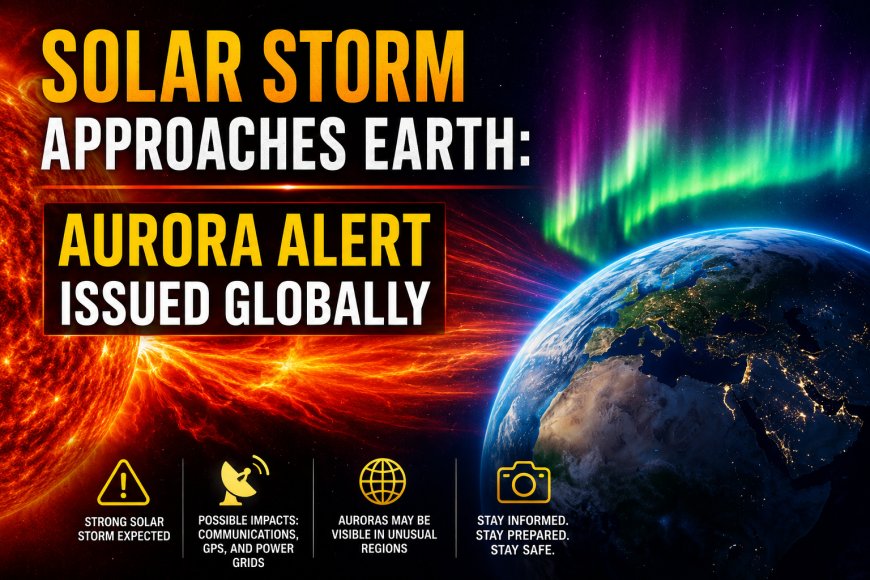
Solar Storm Approaches Earth: Aurora Alert Issued Globally
A strong solar storm heading toward Earth may trigger G3 geomagnetic activity, causing auroras worldwide and possible visibility even in parts of India.
 Ellofacts
Strong Solar Storm Heads Toward Earth; Aurora Displays Possible Across India and Worldwide
A powerful solar storm is moving rapidly toward Earth following a series of intense eruptions on the Sun’s surface, raising global interest among scientists and space weather agencies. The phenomenon may lead to spectacular aurora displays in several parts of the world, including unexpected visibility in India.
Sun Enters Highly Active Phase
According to space weather observations, the Sun has been in an unusually turbulent state over the past week, producing multiple large-scale solar eruptions. These explosive events have released charged particles into space, creating conditions for a strong geomagnetic disturbance.
Solar Storm Approaching Earth
The incoming solar storm is expected to interact with Earth’s magnetic field, potentially causing significant space weather effects. Scientists warn that such interactions can lead to:
-
Bright auroras at lower-than-usual latitudes
-
Disruptions in satellite communications
-
Temporary fluctuations in GPS and radio signals
G3-Category Geomagnetic Alert Issued
Space weather monitoring agencies have reportedly classified the event as a G3 (strong) geomagnetic storm, indicating a high level of solar activity. This category suggests the storm could produce visible auroras far beyond polar regions.
Rare Aurora Visibility Possible in India
If conditions align favourably, sky watchers may witness unusual light displays, including faint auroras in regions where they are rarely seen. Countries across Asia, Europe, and North America could experience enhanced night-sky activity.
Possible Impacts on Technology
Experts note that strong solar storms can sometimes affect:
-
Power grids in high-latitude regions
-
Satellite operations and communication systems
-
Aviation and navigation signals
However, most modern systems are designed to withstand moderate solar events.
Scientific Significance
Researchers are closely monitoring the event to better understand solar cycles and space weather behavior. Such storms help scientists study how solar activity influences Earth’s magnetosphere and technological infrastructure.
Disclaimer: This information is based on early space weather reports and may change as the event develops.