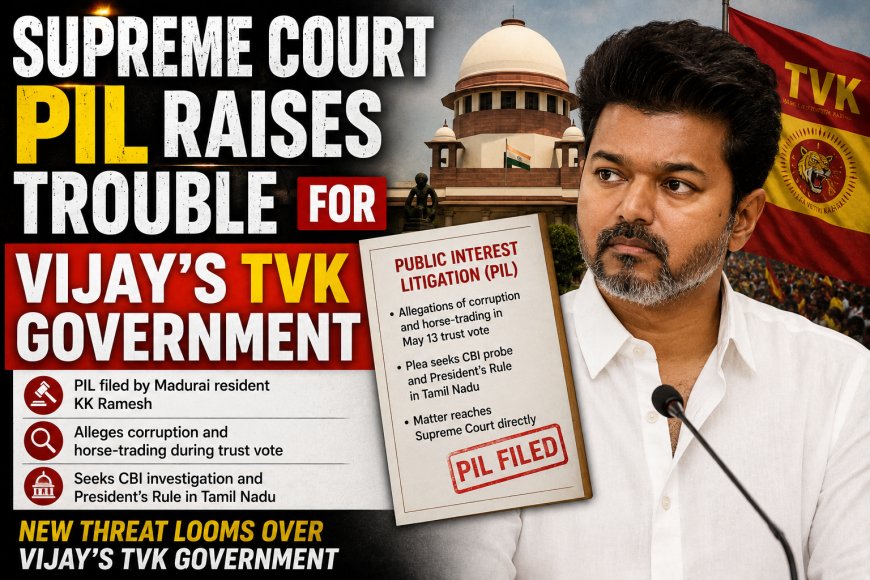
A fresh political controversy has erupted in Tamil Nadu, increasing pressure on the newly formed government led by actor-turned-politician Vijay and his party, Tamilaga Vettri Kazhagam (TVK). Just days after taking power, the TVK government now faces legal scrutiny following the filing of a Public Interest Litigation (PIL) in the Supreme Court alleging corruption and horse-trading during the May 13 trust vote.
The petition, filed by Madurai resident KK Ramesh, seeks a Central Bureau of Investigation (CBI) probe into the confidence vote that allowed the Vijay-led coalition government to remain in power. The plea also reportedly requests the imposition of President’s Rule in Tamil Nadu until the investigation is completed.
According to the petition, the trust vote was allegedly influenced through financial inducements and political deals aimed at securing support from legislators belonging to rival parties and independent factions. The case names the Central Government, the CBI, and the Tamil Nadu government as respondents.
The controversy comes at a sensitive time for the TVK administration, especially as the government prepares for its cabinet expansion on Thursday. Political analysts believe the Supreme Court petition could create major challenges for Vijay’s leadership during the crucial early days of his tenure as Chief Minister.
The TVK emerged as the single largest party in the recent Tamil Nadu Assembly elections by winning 108 seats. However, the party fell short of the 118-seat majority mark required to form the government in the 234-member Assembly. To secure power, TVK formed alliances with several parties, including Congress, CPI, CPI(M), VCK, IUML, along with support from rebel AIADMK MLAs and one MLA from AMMK.
The Vijay government ultimately won the trust vote with the support of 144 MLAs. However, the PIL claims that some lawmakers voted against their party whip, raising concerns about possible violations of democratic norms and anti-defection laws.
One of the biggest flashpoints involves divisions within the All India Anna Dravida Munnetra Kazhagam (AIADMK). Reports indicate that 25 AIADMK MLAs supported the TVK government during the confidence motion, while 22 opposed it. Following the vote, both factions reportedly demanded the disqualification of rival MLAs under anti-defection provisions.
The petition argues that, after the 91st Constitutional Amendment, a simple split within a political party does not automatically grant legal protection to defecting legislators. It states that any legitimate merger requires the support of at least two-thirds of the party’s MLAs.
The petitioner also claimed that the alleged irregularities during the floor test affected the democratic rights of Tamil Nadu voters. The case was filed through advocate Narendra Kumar Verma and is expected to draw significant attention in the coming days.
The Supreme Court has not yet commented on the matter, and it remains unclear whether the court will admit the petition for hearing. Meanwhile, the controversy has intensified political tensions in Tamil Nadu, placing the spotlight firmly on Vijay’s young administration and its stability moving forward.