Government Plans Import Curbs to Support Falling Indian Rupee

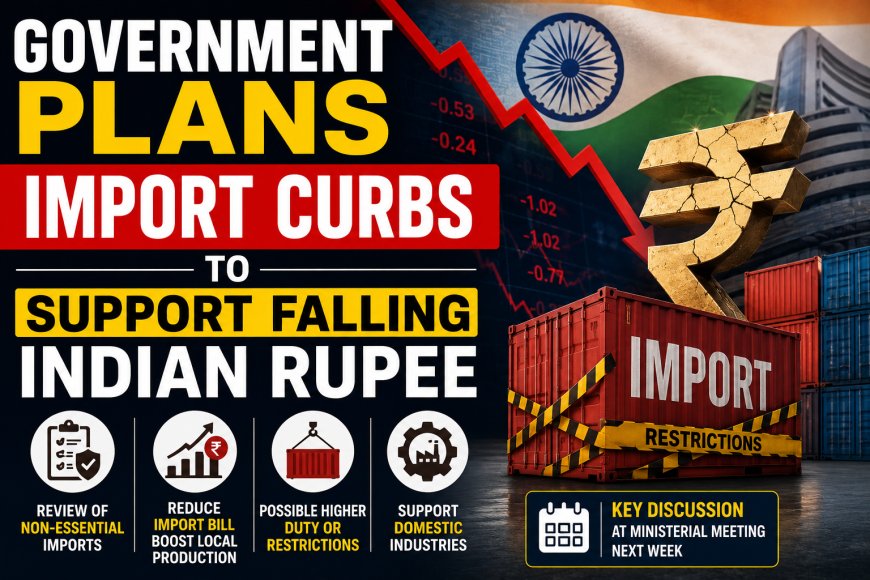
The Indian government may tighten import restrictions and raise duties on non-essential goods to reduce the trade deficit and support the falling rupee.

Government Plans Import Curbs to Support Falling Indian Rupee

Government Plans New Measures to Reduce Imports and Support the Rupee

Amid the continued fall of the Indian rupee and a rising trade deficit, the central government is reportedly preparing fresh measures aimed at reducing imports and encouraging domestic manufacturing. Officials indicate that the focus will mainly be on limiting the import of non-essential goods where India has lower dependence on foreign supply.

The move comes as the Indian rupee recently touched a record low against the US dollar, falling to 96.5 before closing at 96.34 earlier this week. Despite several interventions by the Reserve Bank of India (RBI) in recent months, the currency has continued to remain under pressure.

According to government sources, policymakers are now reviewing sectors where import restrictions or additional duties can be introduced without affecting critical industries or supply chains. The objective is to reduce the country’s growing import bill while simultaneously boosting local production and supporting Indian manufacturers.

The issue is expected to be discussed further during a ministerial-level meeting next week, particularly in the context of the ongoing West Asia crisis and its impact on global trade and energy prices.

India’s trade deficit widened sharply to $28.4 billion in April compared to $20.7 billion in March, raising concerns about pressure on the country’s balance of payments. Challenges such as declining foreign investment inflows and continued foreign portfolio outflows have also contributed to the weakening of the rupee.

Officials have stressed that any new import-related measures will be introduced cautiously to ensure that essential goods, industrial requirements, and strategic sectors remain unaffected. The government’s broader strategy appears focused on strengthening economic stability while encouraging self-reliance and reducing dependence on overseas markets.