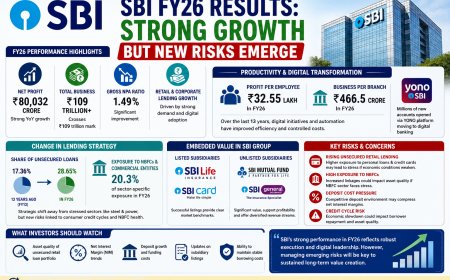
Why SBI Share Price is Falling
SBI share price is falling? Explore key reasons like market weakness, profit booking, interest rate concerns, and investor sentiment.
 Ellofacts
Why SBI Share Price Is Falling: Key Reasons Explained
State Bank of India (SBI), India’s largest public sector bank, is widely tracked by investors. However, like any stock, SBI’s share price sometimes faces downward pressure. A fall in SBI’s share price does not always indicate weak fundamentals; often, it is driven by a mix of market-wide and stock-specific factors.
Let’s understand the main reasons why SBI share price may be falling.
1. Profit Booking by Investors
One of the most common reasons for a fall in SBI share price is profit booking. After a strong rally, short-term investors and traders often sell shares to lock in gains. This selling pressure can temporarily push the stock price lower even when the company’s fundamentals remain strong.
2. Overall Market Weakness
SBI is a heavyweight stock and closely follows broader market trends. When:
-
Sensex or Nifty declines
-
Banking or PSU bank indices fall
-
Global markets turn negative
SBI shares usually move down along with the market, regardless of company performance.
3. Concerns Over Interest Rates
Bank stocks are sensitive to interest rate changes. If there are expectations of:
-
Rising interest rates
-
Pressure on net interest margins (NIMs)
-
Slower loan growth
investors may turn cautious, leading to selling in SBI shares.
4. Asset Quality and NPA Worries
Although SBI has significantly improved its asset quality in recent years, any news or speculation related to:
-
Rising non-performing assets (NPAs)
-
Stress in corporate or MSME loans
-
Economic slowdown affecting borrowers
can negatively impact investor sentiment and cause the share price to fall.
5. PSU Bank Sentiment
SBI belongs to the public sector banking (PSU) space, which often faces valuation pressure due to:
-
Government ownership concerns
-
Lower return ratios compared to private banks
-
Policy-related uncertainties
Weak sentiment toward PSU banks as a whole can drag SBI shares down.
6. Quarterly Results Below Expectations
Even if SBI reports profits, the share price may fall when:
-
Earnings miss market expectations
-
Margins decline
-
Operating costs increase
Markets react not just to growth, but to whether results beat or miss estimates.
7. Global Factors and FII Selling
Foreign Institutional Investors (FIIs) play a big role in large-cap stocks like SBI. If FIIs:
-
Sell due to global uncertainty
-
Shift funds to other markets
-
Reduce exposure to emerging markets
SBI’s share price may come under pressure.
Is the Fall a Concern for Long-Term Investors?
Short-term price declines are common in stock markets. For long-term investors, it is important to focus on:
-
SBI’s strong balance sheet
-
Improving asset quality
-
Market leadership in banking
A temporary fall does not necessarily mean the business is weakening.
Conclusion
SBI share price falls are usually driven by market sentiment, profit booking, interest rate concerns, or global factors, rather than fundamental issues alone. Investors should analyze the broader picture and align decisions with their investment horizon.